Position sizing is the decision of how many shares, contracts or lots to trade, and the reliable way to make it is to start from the loss you can accept, not from the amount you want to invest. Take the dollar amount you are willing to lose on the trade, divide it by the distance between your entry and your stop, and the result is your size. Do it the same way on every trade and no single bad trade can do serious damage to your account.
That is the whole idea. The rest of this guide shows the formula, works through stock and futures examples, explains how to pick your risk percentage, and lists the errors that make a correctly calculated position risk more than you planned. If you want the arithmetic done for you on each alert, PriceWhisperer’s built-in risk management suggests position size and stop-loss levels automatically.
TL;DR
- Position size = (account size × risk %) ÷ (entry price − stop price). The stop comes first, the size follows.
- The two inputs you must decide are where your stop goes and how much of your account you will risk, as CME Group’s education material describes them.
- A wider stop means a smaller position. A tighter stop allows a larger one. Never move the stop just to fit a bigger size.
- Round down, count total open risk across all positions, and recalculate whenever your account balance changes.
- A tool that calculates size for every setup removes the manual math and the rushed errors that come with it.
Table of Contents
- What position sizing is and why it matters
- The two inputs you need
- The position size formula
- Worked example: a stock trade
- Worked example: a futures trade
- Position sizing for stocks, options and forex
- How to choose your risk percentage
- Common mistakes that make a position riskier than planned
- Doing it by hand versus automatically
- Put it into practice
- A simple routine to follow every trade
- FAQ
- Sources
What position sizing is and why it matters
Most new traders ask “what should I buy?” and “when should I get out?” Position sizing answers a third question that decides whether you survive long enough for the first two to matter: how much?
Two traders can take the identical setup, with the same entry and the same stop. One buys 500 shares and the other buys 50. If the stop is hit, one has a painful loss and the other has a minor one. The setup was the same. Only the size differed.
CME Group, the futures exchange operator, notes that position size limits can reflect the risk of a trade and help limit losses, and that stops belong at logical levels, not at random points that ordinary market movement is likely to hit (CME Group, Proper Position Size). Sizing and stop placement are therefore one decision, not two.
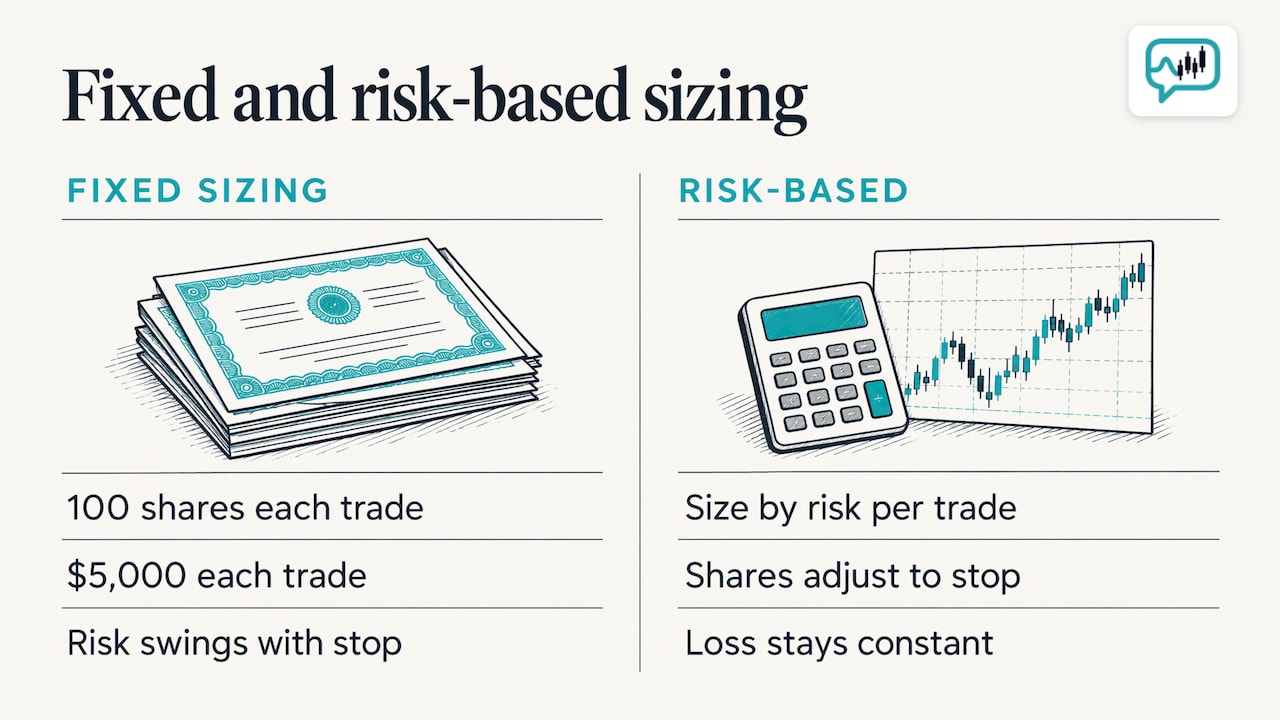
That is why risk-based sizing beats fixed sizing. Buying “100 shares every time” or “$5,000 every time” means your real risk swings wildly from trade to trade, because the stop distance changes with every chart. Sizing by risk makes the loss, not the purchase amount, the constant.
The two inputs you need
CME Group defines the essentials as where you will place the stop and the percentage or dollar amount of your account you are willing to risk (Proper Position Size). Everything else is arithmetic.
1. Your risk per trade
This is a dollar figure, usually set as a percentage of your account. On a $50,000 account, 2% is $1,000, and CME’s table shows 2% of $25,000 is $500 and 2% of $5,000 is $100 (The 2% Rule).
CME calls 2% a popular but arbitrary threshold and says traders can choose tighter or looser parameters as long as they pick a level they are comfortable with and follow it. Many newer traders start at 1% or less because it leaves room for a string of losses.
2. Your stop distance
The stop is the price at which your trade idea is wrong. It should come from the chart (a level the price should not reach if your idea is right), not from the size you would like to trade. Then measure the gap between entry and stop. For stocks, that is dollars per share. For futures, it is ticks multiplied by the tick value.
The position size formula
Position size = dollar risk ÷ risk per unit
Where:
- Dollar risk = account size × risk percentage
- Risk per unit = entry price − stop price (for a long trade; reverse it for a short)
Four steps:
- Multiply your account balance by your risk percentage to get the dollars at risk.
- Choose your entry and your stop from the chart.
- Subtract to find the loss per share.
- Divide the dollar risk by the loss per share and round down to a whole share.
Worked example: a stock trade
You have a $25,000 account and risk 1% per trade.
- Dollar risk: $25,000 × 0.01 = $250
- You plan to buy at $40.00 with a stop at $38.00
- Risk per share: $2.00
- Position size: $250 ÷ $2.00 = 125 shares
The position costs $5,000, which is 20% of the account. That surprises many people: a position can be a large share of your capital and still risk only 1%, because the stop is close. If the stop is hit, you lose about $250.
Now widen the stop to $36.00 because the chart calls for it. Risk per share becomes $4.00, and the size drops to 62 shares ($250 ÷ $4.00 = 62.5, rounded down). Same account, same 1% risk, half the shares. This is the core behavior of risk-based sizing: the wider the stop, the smaller the position.
Worked example: a futures trade
Futures add one step, because each tick has a dollar value. CME’s examples use this logic.
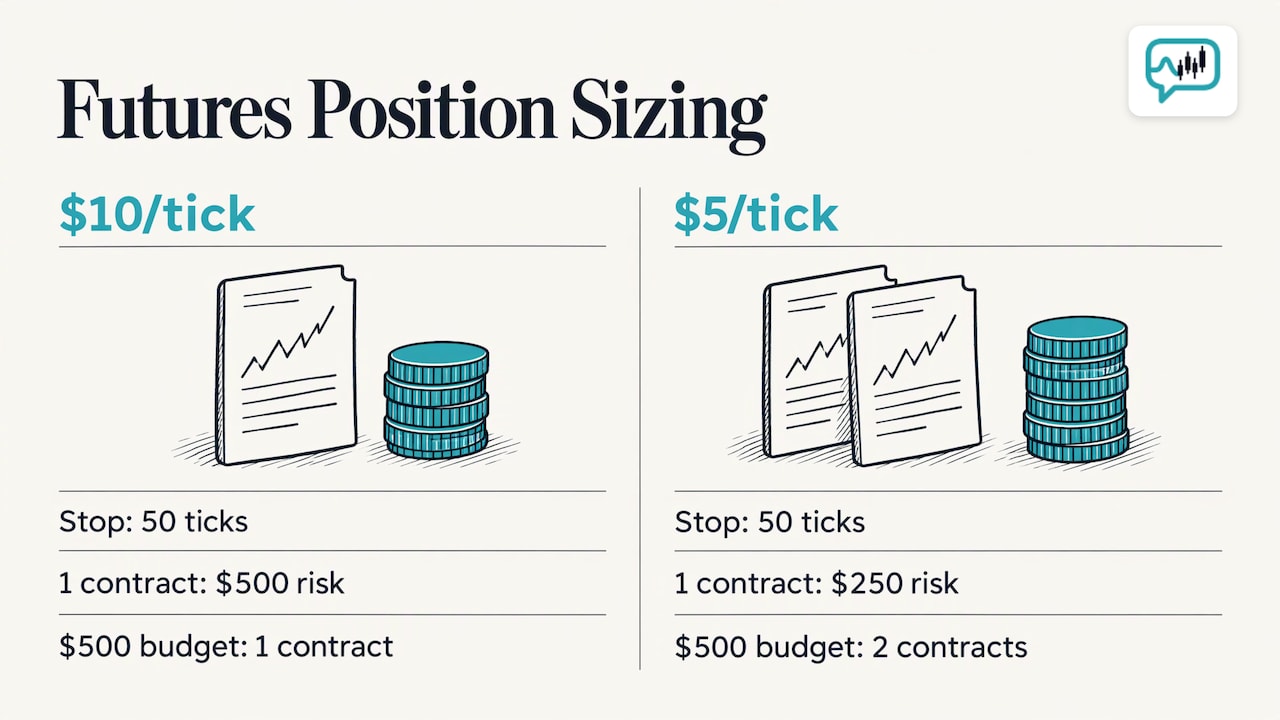
On a $50,000 account risking 1%, you have $500 of risk allowance. A 50-tick stop at $10 per tick risks $500 on one contract. If the tick were worth $5, the same stop would risk $250 per contract, so two contracts fit the budget (Proper Position Size).
CME’s 2% example shows the stop effect clearly. With a $1,000 budget, five Canadian-dollar contracts at $10 per tick with a 20-tick stop risk exactly $1,000. Keep the same budget but use a 50-tick stop and only two contracts are allowed (The 2% Rule).
Position sizing for stocks, options and forex
The logic never changes. Only the unit does.
| Instrument | Risk per unit | Size unit |
|---|---|---|
| Stocks | Entry minus stop, in dollars per share | Shares |
| Futures | Stop distance in ticks × tick value | Contracts |
| Forex | Stop distance in pips × pip value | Lots |
| Options (long) | Premium paid per contract × 100, if you risk the full premium | Contracts |
For forex, a lot is a standard trade unit. A micro lot is 1,000 units of the base currency, written 0.01 on most platforms, and on a USD-quoted pair a pip is worth roughly $0.10 at that size (Vantage Markets lot size guide). So “0.01 lot” describes trade size, not risk. Your risk depends on the stop distance too.
For a long option, the most you can lose is the premium you paid, so many traders set the dollar risk equal to the premium budget. A premium of $2.50 per contract controls 100 shares, so one contract costs $250. With a $250 risk budget, that is one contract. Spreads and short options have different maximum losses, so calculate from the position’s defined or estimated worst case.
How to choose your risk percentage
There is no universal correct number. CME describes 2% as arbitrary, and the better test is practical:
- Can you take ten losses in a row? At 1%, ten straight losses cost roughly 10% of the account. At 5%, they cost about 40%. Recovering from a deep drawdown takes a larger gain than the loss itself.
- Is your edge proven yet? If you are still learning, a smaller percentage keeps each mistake cheap.
- How many positions will you hold at once? Five open trades at 1% each means up to 5% of the account is exposed at the same time.
Pick a figure, write it down, and follow it. The consistency matters more than the exact number. Our guide to risk management fundamentals for traders goes deeper on setting limits, and the trading psychology and discipline lesson covers why traders break their own rules after a loss.
Common mistakes that make a position riskier than planned
The formula is simple. These errors are what break it in live trading.
Choosing the size first, then the stop
If you decide on 500 shares and then place the stop wherever keeps the loss tolerable, the stop no longer reflects the chart. It will either be too tight and get hit by normal movement, or you will quietly move it later. Start from the chart level, then size.
Moving the stop after entry
Widening a stop without reducing the position raises your real risk above the budget you calculated. If the stop must move, the size must shrink to match.
Forgetting gaps
A stop order is not a guarantee of a fill at your price. If a stock opens well below your stop after earnings or overnight news, the loss can exceed the dollar risk you calculated. This is the reason many traders size smaller around events, and why pre-market activity deserves a look before the open.
Ignoring total open risk
Three positions each risking 1% is 3% at risk at once. If they are all long tech stocks, they may move together, so the real exposure is closer to one big bet. Add up your open risk and keep an eye on correlation.
Not rounding down
62.5 shares is 62, not 63. Rounding up pushes you over budget on every trade, and the error compounds.
Using a stale account balance
Risk 1% of what you have now, not of what you started with. After a drawdown, the same percentage means fewer dollars, and the position should shrink with it.
Skipping commissions and slippage
Fees and imperfect fills add to the loss when a stop triggers. For active traders with many trades, include a small buffer.
Doing it by hand versus automatically
A spreadsheet handles one trade well. The trouble starts when you are scanning dozens of tickers before the open, prices are moving, and you have a minute to decide. Typing entry, stop and account size into a calculator for each idea is slow, and a slip in one digit is exactly the kind of error listed above.
That is the problem PriceWhisperer is built around. It scans over 13,000 U.S.-listed stocks and options starting from 4 AM ET and sends alerts based on each ticker’s own historical baseline, with the reasoning behind each alert. Its risk management feature provides automatic position sizing and stop-loss suggestions, so the size is already worked out when you read the alert. You can also connect an Interactive Brokers account to view your positions and P&L next to your risk numbers. PriceWhisperer does not execute trades, so the decision and the order stay with you.
Put it into practice
The Retail Trader plan is $69 per month, with Professional at $149 per month and Desk at $249 per month per seat, and a free trial at onboarding. It includes the 50-module trading education program, which gives you the context behind the numbers, not only the numbers.
See the plans and pricing to pick the one that fits how you trade. If you want to see how sizing and stops fit inside the full alert workflow first, read about built-in risk management and position sizing.
A simple routine to follow every trade
- Update your account balance and set your risk percentage.
- Mark the chart level that proves your idea wrong. That is the stop.
- Calculate risk per share (or per contract, or per lot).
- Divide dollar risk by risk per unit and round down.
- Check that total open risk across all positions stays within your limit.
- Place the order with the stop in place, and do not widen the stop afterward.
If you want a library of related guides, the risk management articles and trading basics guides cover stops, drawdowns and trade planning in more detail.
FAQ
What is position sizing in trading?
It is the process of deciding how many shares, contracts or lots to trade on a given setup. The usual method fixes the dollar amount you can lose and works backward from your stop to find the size. It keeps each trade’s risk consistent no matter how far away the stop is.
How do I calculate position size?
Multiply your account balance by your risk percentage to get the dollars at risk. Divide that by the difference between your entry price and your stop price. For a $25,000 account risking 1% with a $2 stop distance, that is $250 ÷ $2, or 125 shares.
What percentage of my account should I risk per trade?
There is no single right answer. CME Group calls 2% popular but arbitrary and says traders can choose tighter or looser limits if they follow the level they pick (The 2% Rule). Beginners often choose 1% or less so a losing streak stays manageable.
What does 0.01 lot mean?
It is a micro lot in forex, equal to 1,000 units of the base currency (Vantage Markets). It describes the size of the trade, so the dollars you risk still depend on how far your stop is from your entry.
Does position sizing work with a stop-loss that gets gapped?
It still sets the planned loss, but a gap can fill you beyond your stop and make the actual loss larger. Sizing smaller ahead of earnings or known events is how traders allow for that.
Sources
- CME Group: Proper Position Size
- CME Group: The 2% Rule
- Vantage Markets: Micro Lots and Forex Lot Sizes
Recommended
- Built-In Risk Management and Position Sizing
- Relative Valuation Techniques
- Valuation Models and Methods
Discussion on trading for educational purposes, not financial advice!